 Passport photo without appointment


J.M. Mäkelä and Ann-Mari Mäkelä (née Nordberg), the founders of Mäkelä Photo Studio—the predecessor to Memofoto—have been operating in Tikkurila since October 1947. At that time, the Mäkeläs opened a photo studio at Kiertotie 20. It was the first photo studio in Tikkurila; the nearest others had been in Tapanila and Malmi.
J.M. Mäkelä’s first advertisement appeared on April 29, 1950, adorned with red accents in an otherwise black-and-white Helsinki local newspaper. Even then, Mäkelä listed color photo enlargements as his specialty. Otherwise, Mäkelä’s photography work encompassed all kinds of portrait photography: christening, confirmation, wedding, birthday, passport, family, and fashion portraits.
At Memofoto, we strive to carry on the legacy of our predecessors with pride and to produce high-quality photographs and photo prints. Thus, nearly 80 years later, we uphold our traditions and value solid, time-honored professionalism, while still taking into account today’s expectations and requirements, ensuring that our services are always up to date without compromising on quality.
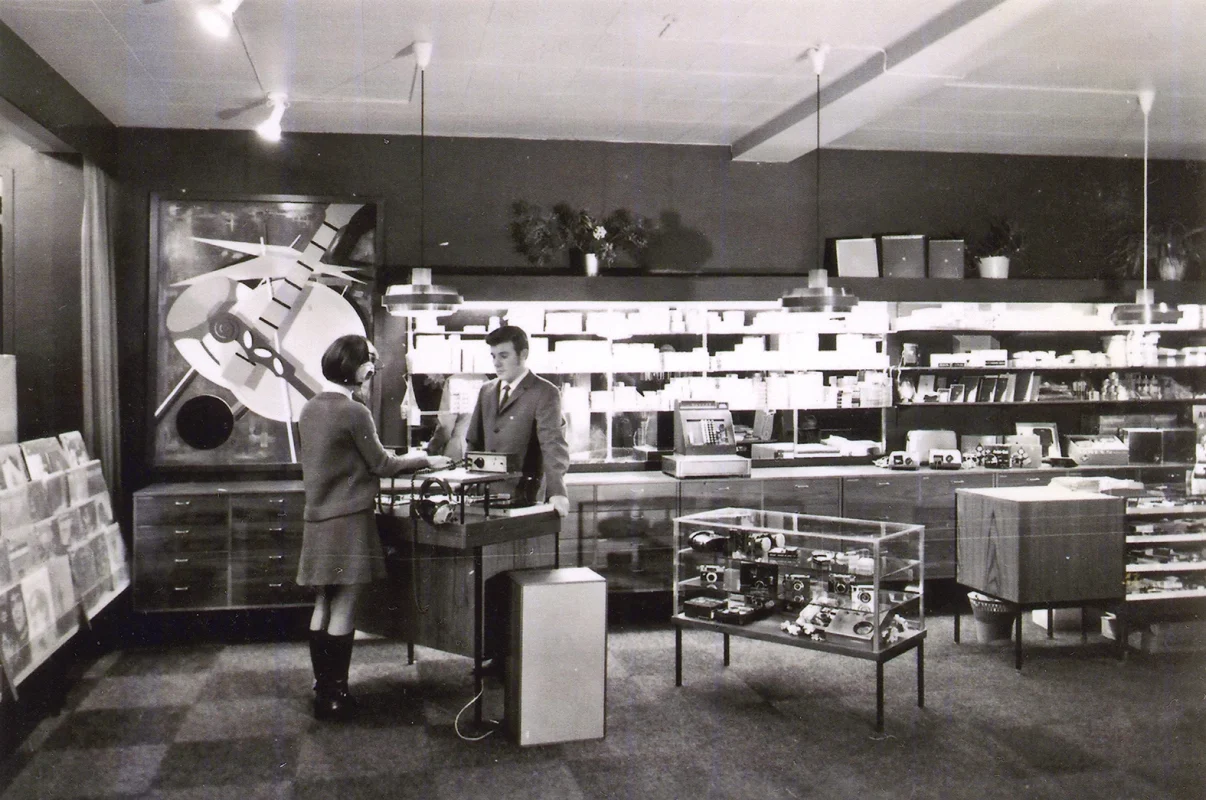
Mäkelä Photo Studio, Tikkurila
Juho Malakias Mäkelä was born in Pori on January 5, 1923. The family moved to Hanko in 1929 and, in the early 1930s, to Kunnanhaka in Helsinki, where their home address became Liisankatu 14. His parents ran a café and a cafeteria, and his father, Juho Eino, also worked as a janitor. During the 1930s, the Mäkeläs acquired a summer home in the Kiertotie area of Tikkurila, then part of the rural municipality of Helsinki. Due to the bombings during the Winter War, the family moved to Tikkurila permanently. Juho Eino and Lyyli Maria Mäkelä later ran a fabric store there.
At the age of 18, Juho M.O. Mäkelä was drafted into military service in January 1942. He received non-commissioned officer training in the 4th Field Artillery Regiment and was assigned to a special unit, the artillery reconnaissance office of the Kannas Group, specifically to the photographic laboratory, which operated in Petäjäniemi, Kanneljärvi, throughout the entire period of static warfare. Mäkelä served in the unit as a laboratory technician and photographer from March 1942 until his discharge at the end of November 1944, receiving thorough training in the field during this time.
Mäkelä’s main photographic duties were related to artillery fire control. The laboratory’s tasks included photographing surveillance panoramas from fire control posts, producing aerial photographs for the artillery, making copies of maps, and manufacturing and printing iron-plate printing plates. The staff consisted of 2 officers and 3–6 non-commissioned officers and enlisted men. Brewster fighters were occasionally used for aerial photography.
The operational environment was driven by technical ingenuity. Long-range and panoramic photography conducted by artillery reconnaissance had only been launched in 1941 at the insistence of General Vilho Nenonen, an internationally renowned artillery theorist. This initiative involved the development of new equipment. Mäkelä had access to an aluminum-framed panoramic camera, model m/1944, and several custom-built systems were constructed specifically at Kanneljärvi. Mäkelä’s civilian career was marked by a preference for high-tech solutions.
In addition to his main assignment, J.M. Mäkelä also photographed the aftermath of the war, and he was called upon to some extent for official photography as well as, for example, portraits of detainees. Among his many assignments, he appears to have been photographing the Finnish peace delegation as it crossed the border on September 8, 1944, on its way to Moscow.
From 1945 to 1947, Mäkelä worked at Heteka Oy, whose best-known product was the “heteka” iron-tube bed.
In 1946, he married Ann-Mari, the daughter of Hjalmar Nordberg, a police officer in Tikkurila. In October 1947, Mäkelä opened a photography studio in Tikkurila at 20 Kiertotie, on the corner of what was then Harjutie. It was the first photo studio in Tikkurila; the nearest others were in Tapali and Malmi, where Mauno Mannelin’s Malmin Valokuvaamo became a serious competitor for the Mäkeläs for decades. In 1949, Foto-Flex emerged as a competitor, announcing that its service area would cover Tikkurila and the surrounding area.
J.M. Mäkelä’s first advertisement appeared on April 29, 1950, adorned with red accents in the otherwise black-and-white *Helsingin Ympäristölehti* newspaper. Even then, Mäkelä listed color photography as his specialty.
Ann-Mari Mäkelä, who was trained in West Germany in the production of color photographs, produced her own color photographs until the Finnish central laboratories began operations.
Mäkelä’s photography business consisted of standard portrait photography: christening, confirmation, wedding, birthday, passport, portrait, and home photos, but also a great deal of other commissioned photography: events, businesses, and products for advertisements. He did not do any actual news photography, not even for local newspapers—he likely didn’t have the time for it. Major clients included, among others, the Schildt & Hallberg dyeing factory, the Helsinki Auto Body Shop, the Greater Helsinki Cooperative Bank, Tikkurila Silkki, and various construction contractors. Even the Agricultural Research Institute occasionally commissioned photographs of its crop trials. In addition to photography, the business sold photographic supplies and developed and printed photos for amateur photographers.
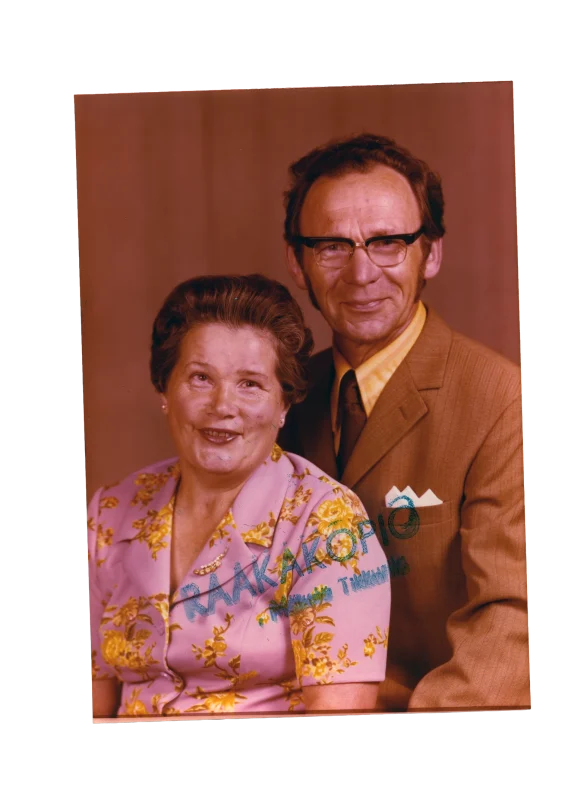
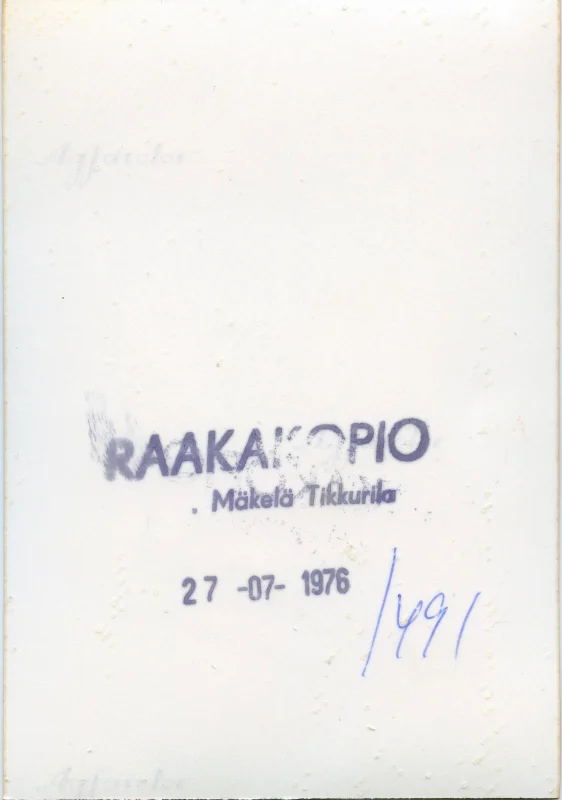
A raw copy photo from 1976 found in a client’s estate archives. (Image usage permission)
In 1953, Kansallis-Osake-Pankki began construction of a modern, three-story “stone palace” at Asematie 2, where the bank’s branch office moved from the Grandi building. Mäkelä managed to secure commercial space in the building for both a photography studio and an entirely new business venture, a textile store that also operated under the name Trimmi J.M. Mäkelä. The stores opened their doors on November 9, 1953, and Mäkelä had moved into the heart of downtown Tikkurila.
Mäkelä’s advertising campaign became more intense at this point. The main focus was clearly on clothing sales, most notably on Silo women’s clothing, for which the exclusive sales rights in Tikkurila were up for grabs.
The Mäkelä business group opened a café-bar on November 1, 1956, at Asematie 1 in the new Kassatalo building in Tikkurila, where the photo studio had also moved. A sewing shop was established in connection with the textile store across the street, and a second textile store was opened at Mäkitie 13 in the new Lohempyrstö building. Operations continued in this configuration, broadly speaking, through 1961–62, after which sales in the textile sector declined.
In 1971, the photo studio also offered offset printing and copying services, as well as a music store; the bar had been replaced by the Kippari-Grilli restaurant at Talvikkitie 18, the textile industry was represented by a school supply store at Asematie 4, and there was a chemical supply store at Talkootie 5 in Hiekkaharju. Mäkelä also made several attempts to enter the music industry through business ventures, but these efforts were short-lived.
At the same time, this diversification of business marked the decline of J.M. Mäkelä’s personal career as a photographer. In practice, at the turn of the 1960s and 1970s, Mäkelä’s photo studio shifted entirely from studio photography to the sale of photography supplies and developing services. Photography duties were handed over to Ann-Mari Mäkelä, her daughters, and the rest of the staff.
The changes of the era and Tikkurila’s rapid urbanization in the 1970s and 1980s showed that only the photography business founded by J.M. Mäkelä—and services, was indeed strong and specialized enough to withstand the competition. The business has since changed its name to MemoFoto Oy, undergone a generational transition, and now operates out of the Asematie 4–10 shopping center in Tikkurila.
Photographer and businessman J.M. Mäkelä died on December 18, 1990. Among his personal hobbies that influenced local culture, sailing is worth mentioning. Mäkelä helped found the Tikkurila Navigation Club (Tikkurilan Navigaatioseura ry), an educational organization that remains active to this day.
A photographic archive from the 1940s through the 1960s, comprising several tens of thousands of negatives, has come to be recognized as historically valuable and remains in the store’s possession. The City Museum has conducted a preliminary inventory of the collection up to the year 1956.1
Author’s Note: Jorma Uimonen lived in Vantaa from 1949 to 1974. He served the City of Vantaa, among other roles, as secretary of the History Committee and later as an expert member starting in 1972, and as director of the City Museum starting in 1986.
1. Material and oral history in the possession of Raili Laakkonen, daughter of J.M. Mäkelä; J.M. Mäkelä’s photo albums, 2 volumes (in the possession of Raili Laakkonen). Key photographic material in digital format in the image archives of the Vantaa City Museum and the Military Museum; Colonel Jyri Paulaharju, Juho Malakias Mäkelä’s Military Career, 1942–1944. Manuscript, 1999; VKM; research material for the Vantaa City Museum exhibition “4 Photographers” (1998); Helsinki Environmental Journal 1949, 1953, 1956–1957; Helsinki Area Address and Occupational Directory 1936; Vantaa Town Guide 1972.
In recent years, Memofoto’s operations were led by the Laakkonen family: Raili, Heimo, and their daughter Eija Laakkonen. In November 2023, when they stepped down from their roles, Margit Lindholm took over responsibility for continuing Memofoto’s operations.